August 2026
By Seth Hallen
Where the Money Moved
How advertising shifted beyond traditional television, why data-driven platforms captured much of the growth, and what media companies can build next.
Adapted from my opening presentation at DPP Production Now, delivered August 13, 2026.
Some Saturday nights, YouTube wins
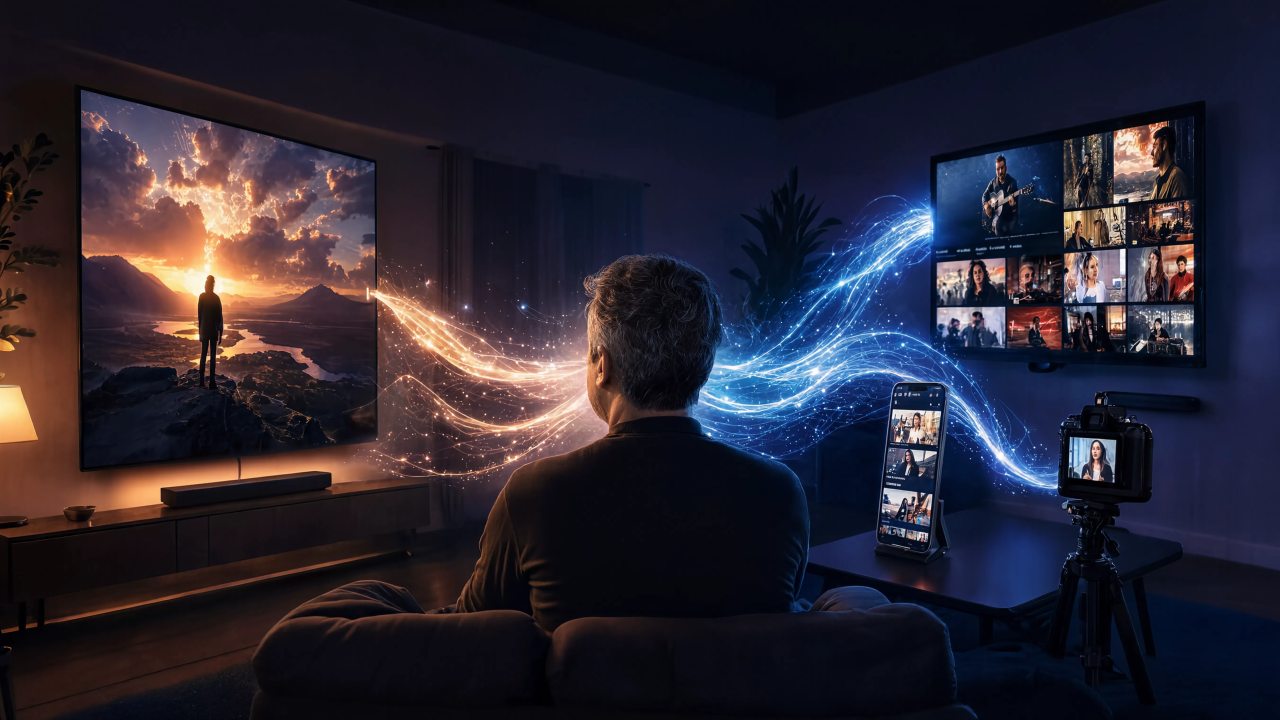
I am about as pre-qualified a customer for premium film and television as anybody. I have spent decades working in this industry. At home, I built my theater around Dolby Vision and Dolby Atmos. A photo of me with Ray Dolby sits on a shelf surrounded by more Blu-rays than any rational person needs. I love movies. I have invested in the experience, and I am willing to pay for it.
Here is what happens. I have about two hours and would love to watch a great movie. I am ready to spend $25 or $30 on a new release. I open one service, browse for a while, then try another. I read descriptions, watch trailers, and scroll through rows of titles. Thirty minutes can go by. Sometimes 45.
There are excellent movies sitting right there. I know I would enjoy many of them. I never get comfortable enough with one choice to commit what remains of the evening.
Then I open YouTube.
My recommendations are full of subjects, people, and channels I already follow. I understand why each video is there. Choosing takes seconds. The remaining hour and a half goes to YouTube, playing through the same big Dolby Vision screen and 12-speaker Atmos system I built for movies.
That evening could have produced a $25 transaction. I was sitting there ready to hand the film business my money, and the system could not close the sale. That frustrates me.
That experience changed how I think about discovery. I wanted to watch a movie and I was ready to pay. The transaction never happened because no title felt like the right choice. When that happens at scale, discovery becomes part of the revenue system.
The production picture is improving unevenly
Hollywood is dealing with a real production contraction. Some early signals are improving, and the benefits are reaching the work economy much more slowly.
Sohonet’s tracked universe of scripted, live-action productions associated with major studios and perennial production companies in the United States, United Kingdom, and Canada showed first-half 2026 starts up 27% from the same period in 2025. They were still 17% below 2022. Its smoothed production-budget measure for June was 36% higher than a year earlier and remained 13% below the 2022 peak.
Meanwhile, Greater Los Angeles recorded 4,711 permitted on-location Shoot Days in the second quarter, down 12.7% year over year. U.S. payroll employment in motion picture and video production was down roughly 8% year over year in June.
Those figures measure different things, in different places, with different lags. Taken together, they describe a pipeline recovering faster than the work economy. The broader media economy continues to grow while less of that growth passes through the traditional scripted-production stack.
Production volume and efficiency address only part of the challenge. Revenue growth depends on how effectively a title reaches an audience and how much value can be created around that relationship.
What the advertising shift tells us
Advertising offers one of the clearest signals.
From 2020 to 2025, IAB estimates that digital video’s share of U.S. television and video advertising increased from 29% to 58%. Spending nearly tripled from $26.2 billion to approximately $73.6 billion.
Digital video includes connected television, online video, and social video. Some of that growth stayed inside traditional media through studio-owned streaming and FAST services. Some of it accrued to premium streamers. A growing portion flowed into platform-governed and creator-driven environments that sit outside the traditional Hollywood supply chain.
That distinction is super important.
Traditional linear television helped fund a production ecosystem built around studios, networks, agencies, crews, vendors, and rights holders. As advertising value shifted toward digital systems, more of the growth began landing in businesses organized around feeds, creators, closed-loop measurement, self-serve ad tools, platform data, and software-driven optimization, much of that living outside the traditional media business.
Audiences were still allocating the same limited attention, but more of the resulting value was captured by different owners, under different margin structures, and through different supply chains.
Within digital video, social video reached an estimated $28.2 billion in U.S. advertising spending in 2025, compared with $26.5 billion for connected television. IAB linked social video’s momentum partly to AI-powered personalization and creator-economy investment. It also pointed to improving outcome delivery in connected television.
What I take from that is fairly straightforward. Advertisers moved more money toward systems that could identify an audience, test the message, measure the result, and improve the next impression.
We can see the difference as consumers. On TikTok, I regularly buy things I did not know existed. On ad-supported streaming, I regularly learn about medications for conditions I do not have. No one in my family needs them. I know a lot of people. I still cannot locate the target audience.
By the sixth repetition, I can recite the side effects. I still do not have the condition.
Premium streaming often pairs world-class content with an advertising experience that feels surprisingly generic. Every irrelevant impression wastes inventory, weakens the advertiser’s result, and makes the viewer less enthusiastic about the ad-supported experience.
Where Hollywood Is Pointing AI
This should change how media companies think about AI.
Most of the public discussion still centers on planning, production, post-production, localization, versioning, time, and cost. Those are useful applications. McKinsey’s interviews with industry leaders found potential productivity improvements of 5% to 10% in selected production use cases, with much of the early activity concentrated in development and pre-production.
Of course we know that production efficiency can lower risk, improve predictability, shorten schedules, and help more projects become economically viable. But media companies should bring the same level of ambition to the audience side of the business.
Discovery, recommendation, audience intelligence, advertising, conversion, retention, and catalog activation all create opportunities for intelligence to add value after the content exists. Recommendation and advertising systems have already been learning from behavior for years. Generative AI expands the range of signals, interfaces, and creative variations those systems can use.
Rather than creating the story, the most economically powerful AI in media may turn out to be the system that helps determine who experiences the story, why it reaches them, and what happens next.
That remains a hypothesis. Public evidence on revenue-side AI is still early, uneven, and frequently company-reported. But the strongest cases today appear in creator matching, campaign optimization, personalization, recommendation, and localization. That is enough to justify serious investment and much better measurement.
The relationship between releases
For most of film and television history, release windows created repeated opportunities to monetize a title over time. Theatrical, home entertainment, pay television, syndication, licensing, and international distribution each created another commercial moment. Streaming rebuilt much of that stack around subscriptions, advertising, bundling, and licensing.
The fan relationship now continues across many more places and for much longer periods.
Deloitte’s 2026 Digital Media Trends survey found that 55% of fans said being a fan often leads them to engage with a show, artist, or franchise across multiple platforms. 52% said social media is their primary way of discovering new entertainment. 44% said they discover content on social media and then go somewhere else to watch, listen to, or buy the full version.
The survey maps behavior rather than revenue. It shows a fan journey that rights holders and streaming services often cannot see from beginning to end. Discovery may happen on one platform, discussion on another, commerce somewhere else, and the eventual viewing transaction on a streaming service. The audience experiences one continuous relationship while the company may see several disconnected events.
This is what I mean when I say fandom can become a new window for stories that build durable communities. It adds an ongoing engagement and monetization layer alongside traditional release windows. Fans keep discovering, discussing, creating, attending, buying, and returning between major releases. Each interaction can create useful signal for the next one.
This will matter much more for some titles than others. Some stories are complete in themselves. Others create communities that persist for years.
We can already see pieces of this model in several businesses. Formula 1 reported $3.9 billion in revenue in 2025 across a business that includes media rights, sponsorship, attendance, hospitality, and licensing. Crunchyroll reported more than 21 million paid subscribers, while its 2026 Anime Awards drew 73 million votes. Paramount reported that UFC brought a younger audience into Paramount+ and led many of those viewers into the broader service.
The figures are company-reported and specific to those properties. They illustrate a relationship that persists, creates multiple points of participation, and gives the owner more opportunities to learn.
The emotional bond will always come from the story, the characters, and the community, and the talent, taste and judgement of the storyteller is more important than ever.
AI can help the system remember what happened and make the next interaction more relevant. A company can only learn from relationships it can lawfully see and use, which puts data, rights, measurement, privacy, and partnerships at the center of the operating model.
The practical goal is to make the path to the story more relevant while leaving the story itself intact.
Back in the living room
Back in my living room, the room is ready. The customer is willing to pay. There is more to watch than I could ever finish.
The advantage belongs to whoever can help me choose with confidence, make the experience worth my time, and keep the relationship alive after the credits.
I love this business. I am betting on it.
The next two viewing hours belong to whoever earns them.
Originally published on LinkedIn by Seth Hallen